
How do you grill directly on a kamado BBQ?
Direct grilling on the kamado BBQ means your food sits above the glowing charcoal without a heat shield, usually between 220 and 260 degrees Celsius. This quickly gives a crispy outside, grill marks and that roasted flavour. Keep the lid closed as much as possible for a stable temperature and less chance of flames.
- Working temperature usually 220-260 degrees Celsius, up to 300 degrees for searing
- Keep the lid closed for stable temperature and fewer flames
- Cast iron grate gives the nicest grill marks and crust
- Flames are usually caused by dripping fat, not the kamado itself
- For thick cuts, reverse sear is often a better alternative
Direct grilling is the “classic” BBQ move: fire underneath, grate on top, food on top. Simple. But on a kamado (like the Grill Bill) you can do it in such a controlled way that it suddenly feels like you're cheating. In this article you'll learn exactly how to grill directly on a Grill Bill: temperature, airflow, grate choice, timing and how to tame flames without panicking.
Prefer to cook slowly without direct radiant heat from the fire? Then also check out indirect cooking on a kamado. For an extra layer of flavour, add smoking on a kamado.
What is direct grilling on the kamado (and why is this the fastest route to flavour)?
With direct grilling your food sits above the charcoal, without a heat shield in between. This gives you a lot of radiant heat and contact heat from the grate. Result: fast cooking, a crispy outside, grill marks and that roasted flavour you went outside for in the first place.
Temperature: these are your sweet spots
For direct grilling on the Grill Bill you're usually fine between 220 and 260°C dome temperature. That's hot enough for a nice crust, without everything turning black within 30 seconds.
- Steaks & burgers: 230-260°C
- Chicken (thigh fillet/wings): 220-240°C
- Vegetables: 200-230°C
- Searing/finishing: up to ±300°C (burp it!)
Tip: a kamado is not an open grill. Keep your lid closed, then your temperature stays stable and everything cooks more evenly.
Airflow: lid closed, control on
On the Grill Bill you control heat with oxygen. More air = hotter. Less air = calmer. Sounds logical, but the “pitfall” is opening the lid too often. That drives oxygen inside and you get flames or fluctuating heat faster.
Rule of thumb: only open the lid when you need to do something. Then close it again. The kamado does the rest.
Grate choice: stainless steel or cast iron?
You can grill perfectly well on both. But if you love a sturdy crust and clear grill marks, then cast iron is your best friend. Cast iron absorbs a lot of heat and gives it straight back to your meat.
Pro tip: always give your grate (especially cast iron) time to get thoroughly hot. Think: 8-10 minutes at temperature before you start.
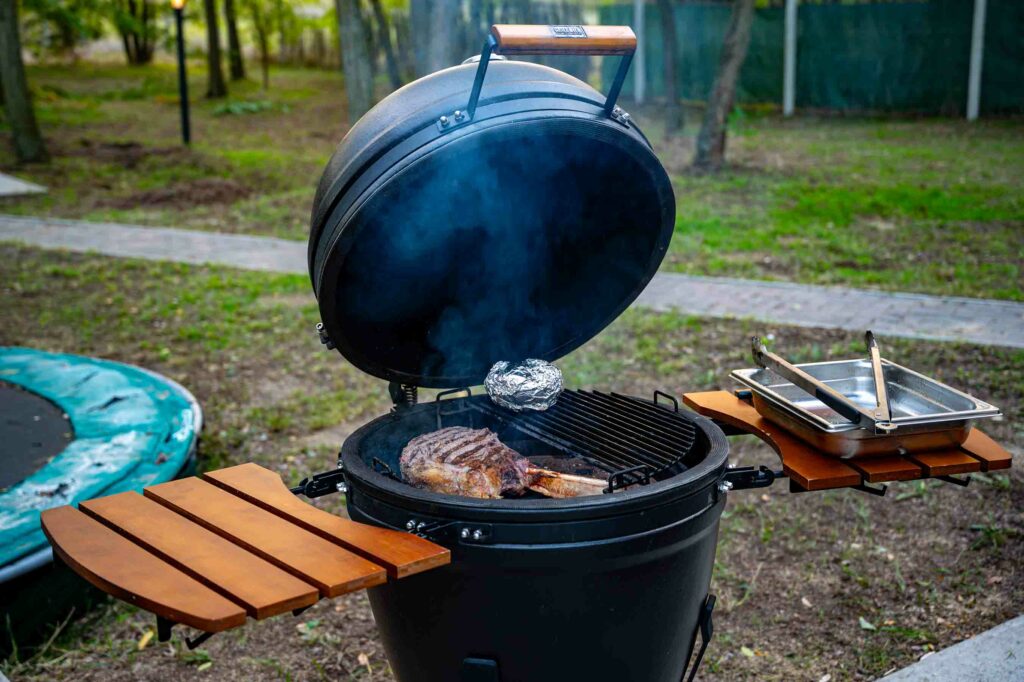
Recipe for grilling on the kamado
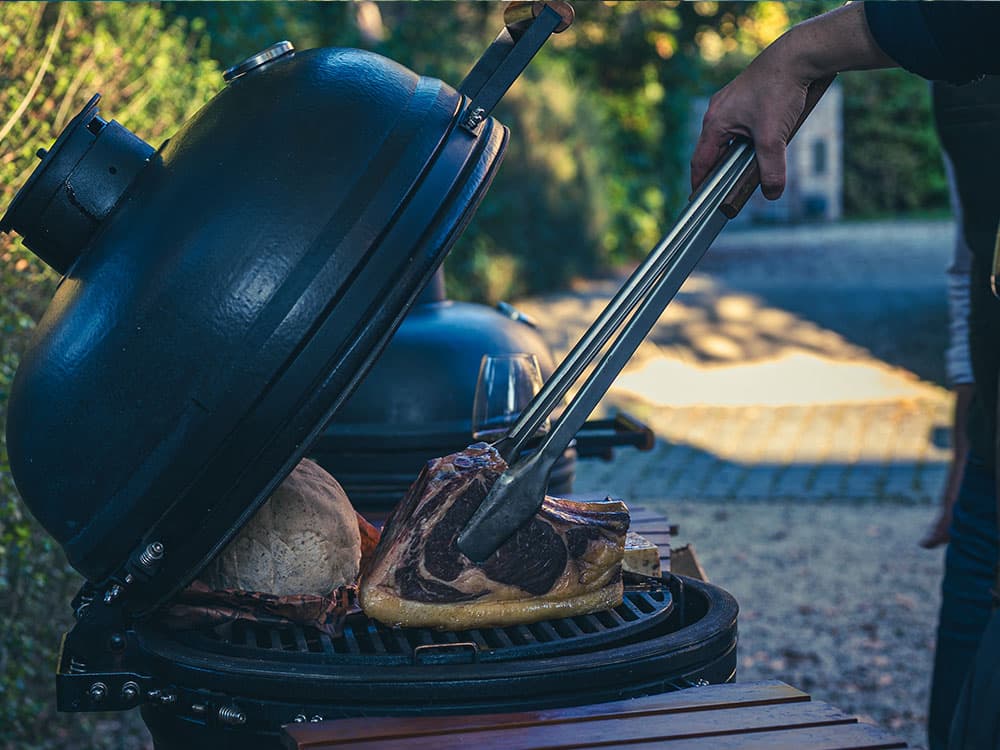
Recipe: Grilling the Tomahawk
Preparing a tomahawk steak on the Kamado BBQ is a true art that every BBQ lover wants to perfect.
How to prevent flames (without steaming your food)
Flames are almost always caused by dripping fat. That's not a disaster, but you don't want your steak turning into a torch. This helps:
- Lid closed when it flames: oxygen gone = flame gone.
- Work with zones: don't place fatty meat right above the hottest spot.
- Don't poke it (juice + fat = extra flame party).
- Clean your grate: old fat = flare-ups sooner.
Burping: learn this before you go to 300 degrees
If your kamado is hot, opening the lid all at once can cause a flash flame (backdraft). Burping is simple: open a small gap first, wait a second, then open further. This lets oxygen in in a controlled way.
Bonus: your eyebrows stay where they belong.
When direct grilling is less smart (and what to do instead)
Direct grilling is great for quick cooks. But with thick cuts (e.g. thick steak, larger bone-in chicken pieces, or a roast) the outside can go too fast. Then reverse sear is ideal: cook indirectly first until almost at core temperature, then finish briefly and hot for the crust.
Want to go that route? Then indirect cooking is the basis.
Quick checklist: direct grilling on the Grill Bill
- Kamado at 220-260°C
- Preheat the grate properly
- Pat the food dry (better crust)
- Lid closed, only open when needed
- With flames: lid closed and burp calmly
- After grilling: rest briefly (especially with steaks)
Want to discover more techniques? Dive into the full overview at Kamado BBQ and build up your outdoor kitchen skills step by step.
The difference between direct grilling and other cooking techniques
The table below shows how direct grilling compares to other kamado cooking techniques.
| Cooking technique | Temperature | Method | Best for | Difficulty | Handy accessories |
|---|---|---|---|---|---|
| Direct grilling | 200-300°C | Directly above glowing charcoal | Steaks, burgers, sausage, prawns, vegetables | Easy | Cast iron grate, tongs, heat-resistant gloves |
| Indirect cooking | 90-200°C | With heat deflectors, like an oven | Whole chicken, pork shoulder, ribs, oven dishes | Easy | Heat deflectors, multilevel system |
| Smoking | 90-140°C | Indirect + smoking wood | Ribs, pulled pork, brisket | Medium | Smoking wood chunks, thermometer |
| Baking | 180-300°C | Indirect, often with pizza stone | Pizza, bread, tray bakes | Medium | Pizza stone, peel, deflectors |
| Roasting | 160-230°C | Indirect with radiant heat | Vegetables, potatoes, whole chicken | Easy | Multilevel, drip pan |
| Stewing | 110-180°C | Indirect in (Dutch) oven, with liquid | Short rib, stew, lamb, beans | Medium | Dutch oven, heat deflectors, thermometer |
| Wok cooking | 200-350°C | Direct with wok (ring), fast heat | Stir-fry, noodles, vegetables, prawns | Medium | Wok (ring), cast iron grate, long tools |
| Steaming | 90-130°C | Indirect with water/liquid, closed dome | Fish, dumplings, vegetables, bao | Medium | Steamer basket, drip pan/water bowl, deflectors |
| Baking in embers | 180-250°C | Indirect in ash/foil packet, long cook | Potatoes, beetroot, celeriac, corn | Easy | Gloves, tongs, (half) deflectors |
| Afterglow | 70-150°C | Residual heat, airflow almost closed | Carry-over cooking, keeping warm, vegetables, dessert | Easy | Thermometer, pan or Dutch oven |