
What is indirect cooking on the kamado BBQ?
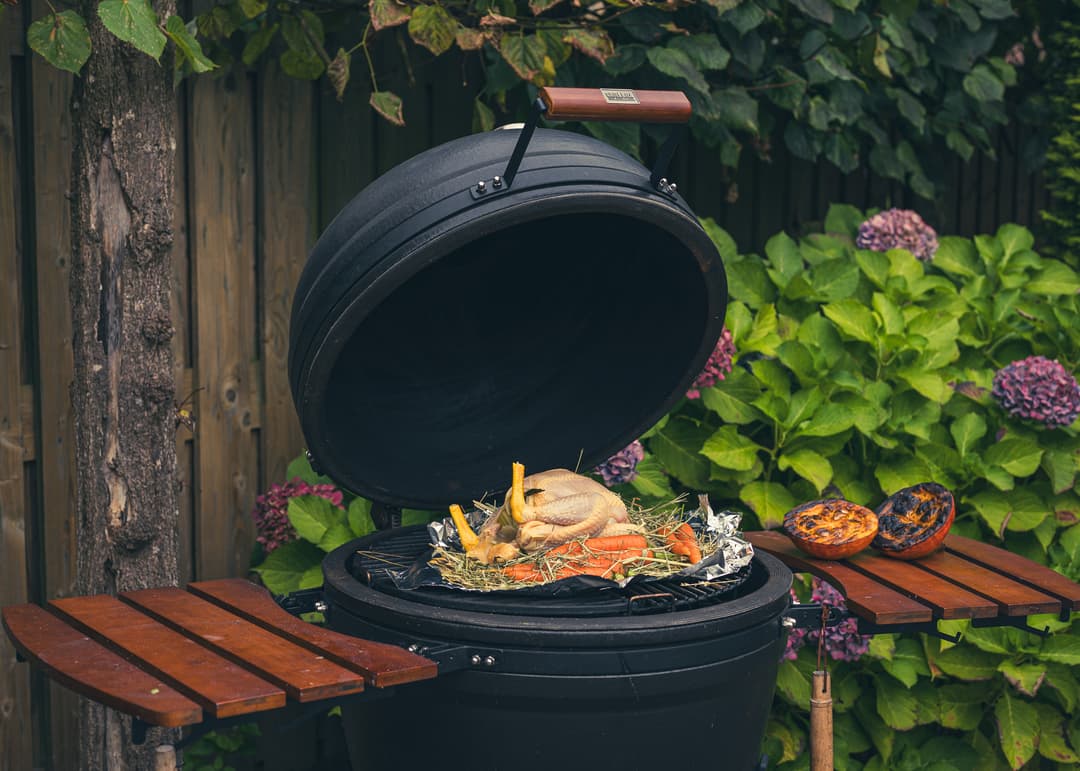
Indirect cooking on the kamado BBQ means placing a ceramic heat shield between the charcoal and your food. This way your food doesn't get direct radiant heat, but cooks evenly through the warm airflow in the kamado, just like in an oven. This technique is ideal for whole chicken, pulled pork, ribs and oven dishes that need time and constant heat.
- A ceramic heat shield blocks the direct heat from the charcoal
- Working temperature usually between 110 and 200 degrees Celsius
- Ideal for whole chicken, pulled pork, ribs and oven dishes
- Combine with direct grilling for a reverse sear and a nice crust
- Open the lid as little as possible for a stable temperature
Indirect cooking is the reason people fall in love with a kamado. You turn your Grill Bill from a “grill with coals” into a ceramic hot air oven you can cook stably on for hours, low or higher, without your dish going up in flames. Think: chicken with crispy skin, pulled pork, whole fish, ribs, oven dishes, bread... anything that needs time and even heat.
Want to go fast over direct heat instead? Then check out direct grilling. And if you want to give your indirect session an extra layer of flavour right away: smoking is your best friend.
What is indirect cooking on the kamado BBQ (and why is it so relaxed)?
With indirect cooking you place a ceramic heat shield between the charcoal and your food. That way your food gets no direct radiant heat from the coals, but an even warm airflow (convection) through the kamado. Result: constant cooking, less risk of burning, and super tender results.
On a Grill Bill you do this with your heat deflectors / ceramic heat shields (on some sets: half deflectors), often combined with a multilevel system so you can play smartly with height and zones.
What do you need?
- Your Grill Bill kamado + charcoal
- A good firelighter/firelighter cubes (no lighter fluid, nobody's happy about that)
- Grate (stainless steel or cast iron)
- Heat shield / heat deflectors (ceramic)
- (Optional) drip pan for fat/liquid, especially with fatty cuts
The principle is simple: heat shield in → grate on top → lid closed → control airflow → the kamado does the work.
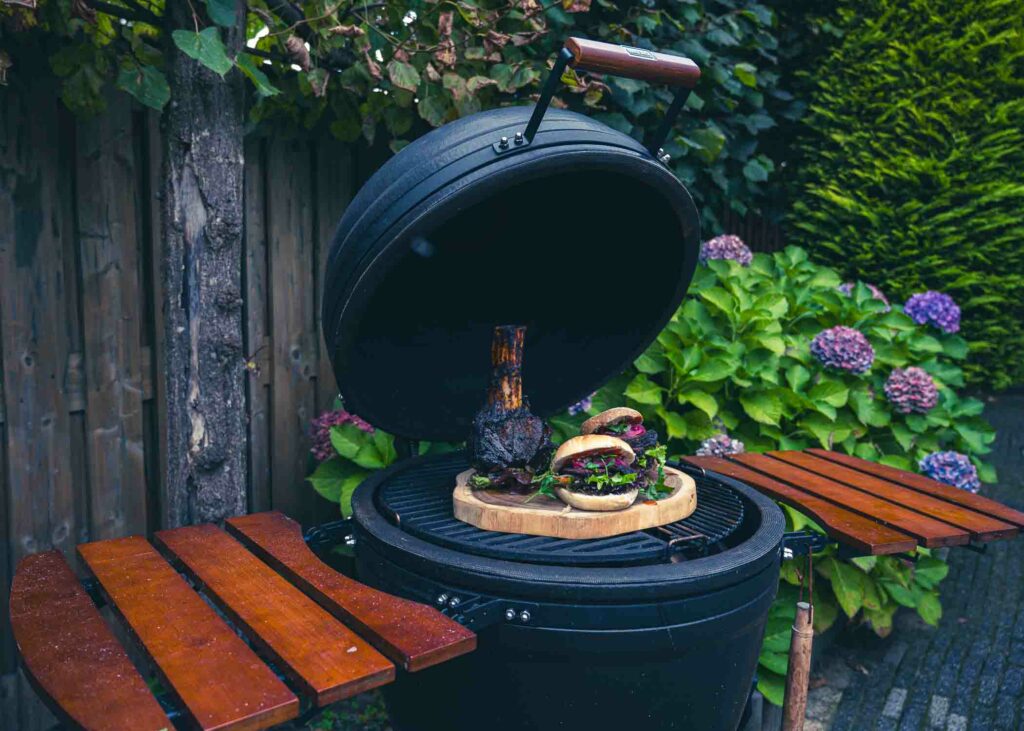
Recipe for indirect cooking on the kamado
Recipe: The Beefhammer
The beefhammer is an impressive cut of meat that owes its name to its striking, bone-shaped presentation. This is the top of the beef shoulder, and because of its coarse structure it's perfectly suited to low & slow cooking.
How to set up indirect cooking on the kamado BBQ (step by step)
1) Fill your kamado generously
Indirect sessions can take a long time. So: fill your firebox properly before lighting it. Nothing as annoying as having to top up halfway through.
2) Light it and let it start up calmly
Light your charcoal and give the kamado time to stabilise. Don't rush: you want a constant base before adding accessories and food.
3) Place your heat shield, then your grate
Place your ceramic heat shield(s) so the direct heat is blocked, and place your grate on top. This is how you build your “oven”.
4) Bring the kamado to the right temperature
Many indirect recipes run somewhere between 110-180°C (low & slow and slow cooking), but indirect can also work fine at higher temperatures. A practical example: chicken indirect around 180-200°C for a crispy outside and juicy inside.
5) Add the food and... leave the lid alone
Indirect cooking works best when you let the heat circulation do its job. Open the lid as little as possible. Every time you look, heat escapes and your kamado has to stabilise again.
6) Check doneness with time and core temperature
You can work with guideline times, but for seriously tasty (and stress-free) cooking a core thermometer is gold. For chicken a core temperature around 77°C is often used (depending on the cut and recipe).
Combining indirect cooking and grilling (hello, reverse sear)
Indirect cooking is also your secret weapon for thick steaks or larger cuts: cook indirectly and calmly first until almost at your desired core temperature, then finish briefly and hot for that brutal crust. This is exactly why a kamado is such a great beast: you can combine techniques without hassle.
Safety: preventing backdraft (burp it, always)
Even with indirect cooking, your kamado can be quite hot. So open the lid carefully in 2 steps (burp it): first a crack, wait briefly, then open further. This prevents a flash flame from a sudden inflow of oxygen.
After the session: extinguish it properly and clean up
Done? Close your air vents (top and bottom) so your kamado goes out. Then clean your grate and accessories. Saves hassle next session and keeps your kamado happy for longer.
The difference between indirect cooking and other cooking techniques
The table below shows how indirect cooking compares to other kamado cooking techniques.
| Cooking technique | Temperature | Method | Best for | Difficulty | Handy accessories |
|---|---|---|---|---|---|
| Direct grilling | 200-300°C | Directly above glowing charcoal | Steaks, burgers, sausage, prawns, vegetables | Easy | Cast iron grate, tongs, heat-resistant gloves |
| Indirect cooking | 90-200°C | With heat deflectors, like an oven | Whole chicken, pork shoulder, ribs, oven dishes | Easy | Heat deflectors, multilevel system |
| Smoking | 90-140°C | Indirect + smoking wood | Ribs, pulled pork, brisket | Medium | Smoking wood chunks, thermometer |
| Baking | 180-300°C | Indirect, often with pizza stone | Pizza, bread, tray bakes | Medium | Pizza stone, peel, deflectors |
| Roasting | 160-230°C | Indirect with radiant heat | Vegetables, potatoes, whole chicken | Easy | Multilevel, drip pan |
| Stewing | 110-180°C | Indirect in (Dutch) oven, with liquid | Short rib, stew, lamb, beans | Medium | Dutch oven, heat deflectors, thermometer |
| Wok cooking | 200-350°C | Direct with wok (ring), fast heat | Stir-fry, noodles, vegetables, prawns | Medium | Wok (ring), cast iron grate, long tools |
| Steaming | 90-130°C | Indirect with water/liquid, closed dome | Fish, dumplings, vegetables, bao | Medium | Steamer basket, drip pan/water bowl, deflectors |
| Baking in embers | 180-250°C | Indirect in ash/foil packet, long cook | Potatoes, beetroot, celeriac, corn | Easy | Gloves, tongs, (half) deflectors |
| Afterglow | 70-150°C | Residual heat, airflow almost closed | Carry-over cooking, keeping warm, vegetables, dessert | Easy | Thermometer, pan or Dutch oven |
Want to move on to the next technique? Continue to Smoking or Baking. And for the full overview: Kamado BBQ.