
Why does the thermometer in my kamado read differently?
- The dome gauge measures the air at the top, not the grate
- The ceramic needs time to heat up evenly
- Test your gauge in boiling water: it should read 100 °C at sea level
- Many analogue gauges can be adjusted with a nut on the back
- Fogged glass or a needle that sticks: time to replace it
A kamado thermometer reads differently more often than you might think, and usually nothing is broken. The gauge says 180 °C, yet your pizza stays pale or your meat burns on the outside. Then you start to wonder: is that gauge still accurate, or is my kamado doing something odd?
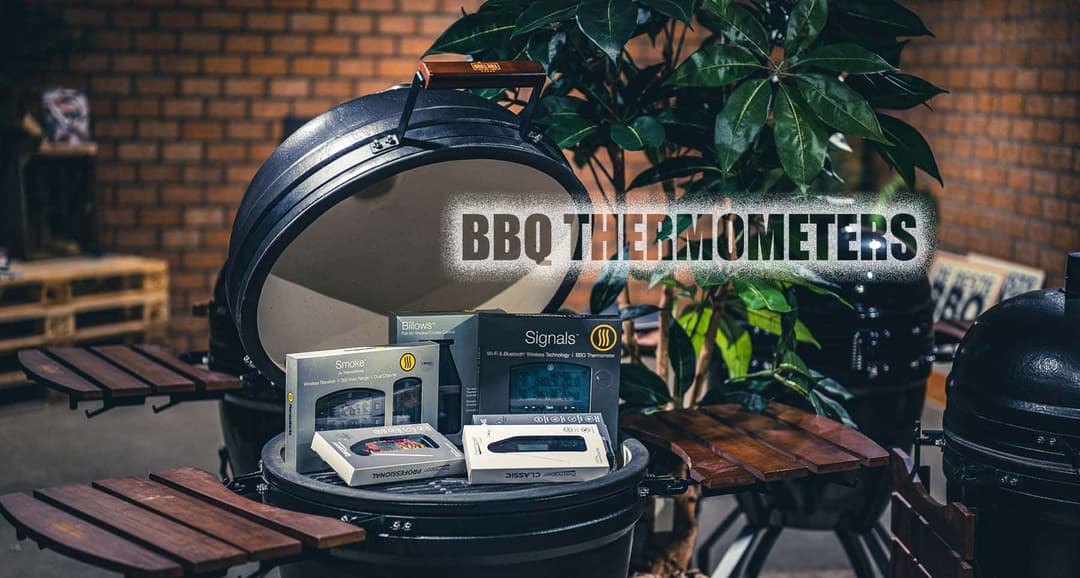
In this article you will learn why the temperature in the dome differs from the one on the grate, how to check your gauge with a pan of boiling water, and when it is time to buy a new one. Looking for advice on which type of thermometer to choose? That is covered in our buying guide for BBQ thermometers.
Why your kamado thermometer reads differently from the grate
The gauge in the lid sits in the dome and measures the air at that point. Your food sits a good deal lower, on the grate. In a kamado the heat is not the same everywhere: hot air rises to the dome, while the grate is either closer to the charcoal or shielded by a heat deflector.
The difference depends on how you cook:
- Direct grilling: the grate is close to the coals and can be much hotter than the dome suggests.
- Indirect cooking: with a heat deflector in between, the grate can be cooler or more even than the dome. You can read more about that technique in our article on indirect cooking on the kamado.
- High temperatures: the hotter your kamado, the bigger the gap between dome and grate can become.
A difference of ten to twenty degrees between dome and grate is therefore normal and says nothing about the quality of your gauge.
The position of the gauge decides what you see
Where the gauge sits and how deep it reaches into the dome makes a difference. A gauge just below the rim of the lid measures slightly differently from one hanging in the middle of the dome. Airflow plays a part too: next to the top vent the air moves differently than on the other side.
Want to know what really happens at grate level? Place a second thermometer at grate height, for example a wireless probe that you lay next to your food. Compare it with the dome gauge over a few sessions. That way you discover the fixed difference for your kamado and learn which number to aim for on the dome gauge.
Also check the gauge itself. If the probe is loose, crooked, or touches the ceramic or a heat deflector, you will read a wrong value.
The ceramic needs time to heat up
Ceramic absorbs heat slowly and releases it just as slowly. That is exactly the strength of a kamado, but it causes confusing readings while heating up. The air in the dome is hot within a quarter of an hour, while the wall and the grate are nowhere near temperature yet.
So give your kamado time to stabilise. Let the gauge sit at the target temperature for a while before you put food on. Only then is the heat evenly spread and do dome and grate agree best.
- Do not open the lid too often: heat escapes every time and the gauge drops quickly.
- After opening it takes a moment before the gauge shows a reliable value again.
- With a cold start or after rain, heating up takes longer.
The boiling water test: how to check your gauge
Want to know whether the gauge itself is still right, regardless of dome and grate differences? Then boiling water is your reference. At sea level, water boils at 100 °C. In the Netherlands that is a fine starting point.
- Bring a pan of water to the boil and let it boil properly for a minute or two.
- Take the gauge out of your kamado. With a dome gauge, unscrew the probe or carefully pull it out of the lid.
- Hold the probe in the boiling water without letting it touch the bottom or the side of the pan.
- Wait until the needle or display stops moving and read the value.
If the gauge shows 100 °C, it is accurate. If it reads 95 °C or 105 °C, you know the fixed difference and can either allow for it or adjust the gauge. If you live far above sea level, water boils at a lower temperature, so keep that in mind.
Adjusting with the nut on the back
Many analogue dome gauges have a small nut or adjustment screw on the back. You can use it to adjust the needle. If your gauge does not have one, you cannot adjust it, so remember the difference or replace the gauge.
- Hold the probe in boiling water, as in the boiling water test.
- Grip the nut on the back of the gauge with pliers or a spanner. Hold the gauge firmly so that the probe does not twist.
- Slowly turn the nut until the needle points to 100 °C.
- Let the gauge cool down and repeat the test to check that the setting holds.
Do not force it. If the nut will not move or the needle jumps back, the mechanism is worn and replacing is wiser than adjusting.
Condensation and fogged glass
A fogged dial is a common problem with analogue gauges. It means there is moisture inside the housing. A little condensation after a cold, damp day can appear briefly and often disappears when the kamado warms up. If the glass stays fogged, the gauge is no longer properly sealed and the mechanism will eventually rust or stick.
You can recognise a gauge with moisture problems by:
- a dial that stays fogged even after warming up,
- a needle that reacts slowly or sticks,
- rust spots or a stained background behind the glass.
A gauge that behaves like this not only gives a deviating value, but also becomes less and less reliable.
When do you replace the thermometer?
Replace your gauge if, after the boiling water test, it is far from 100 °C and cannot be adjusted, if the needle sticks, or if the glass stays fogged. A bent probe or a loose housing are also reasons to get a new one.
You will find new thermometers in our BBQ thermometers. Which type suits the way you cook is explained in the buying guide. Want to know for certain when your meat is done? A probe thermometer gives the most reliable result, see our article on when your meat is done.
Did you receive a new kamado with a gauge that is already off or damaged? Then please contact us and we will take a look. You can find all kamados on the kamado BBQ page.
FAQ: thermometer in the kamado
Is it normal for the dome gauge to differ from the grate by 20 degrees?
How do I test whether my kamado thermometer is still accurate?
How do I adjust an analogue thermometer?
Why is my thermometer glass fogged up?
How long should I let my kamado heat up before the gauge is reliable?
Can I put an extra thermometer on the grate?